
Learning outcomes for supply chain and operations courses
ChainSim turns procurement, production, inventory, transport and customer-delivery concepts into a practical decision exercise. Students see the operational and financial consequences of their choices, then use results evidence to explain what happened and how they would improve.
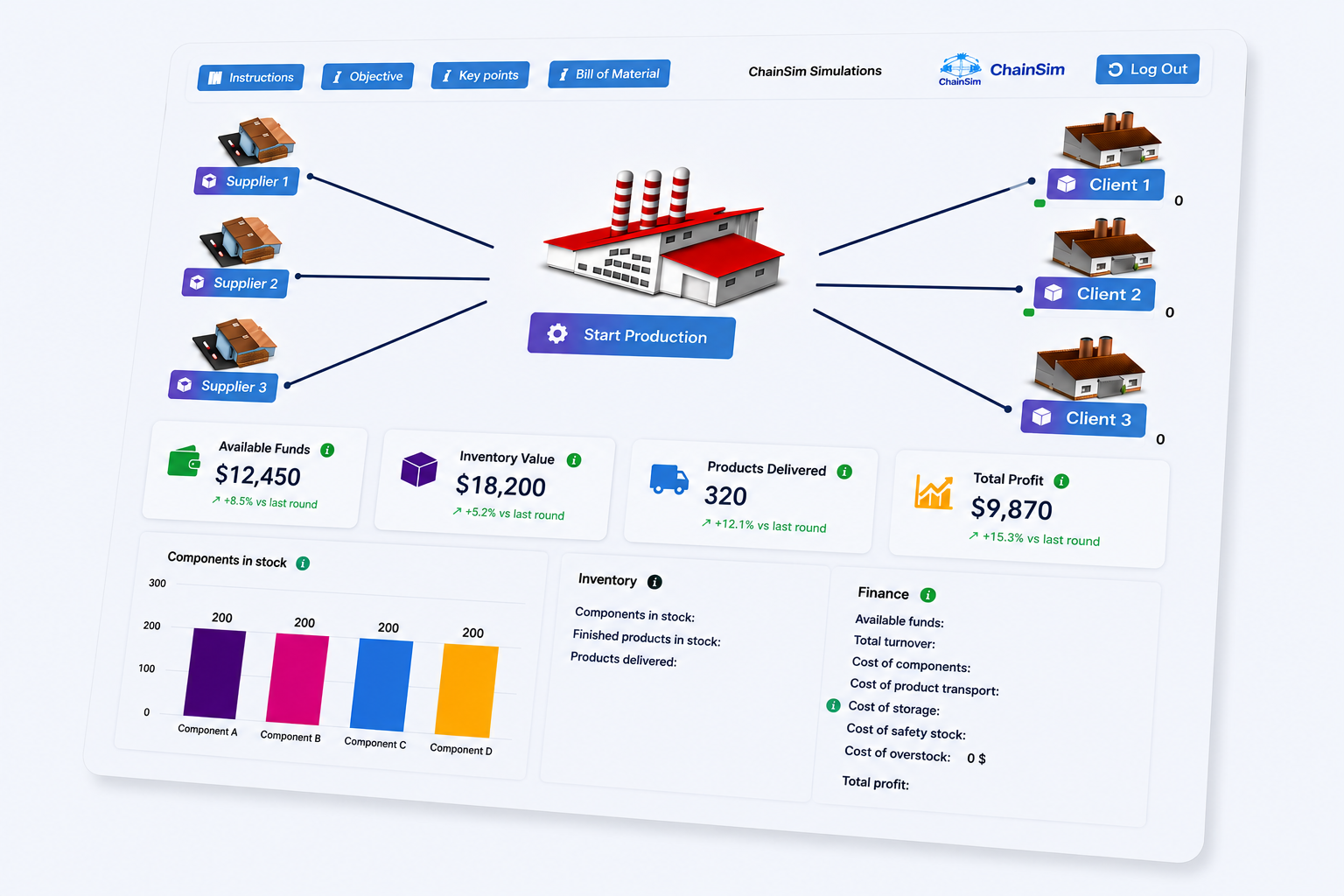
Across the course sequence, students should be able to…
Each outcome connects an observable student action to evidence instructors can use in discussion and assessment. Use ChainSim as a formative activity or combine submitted results with your own reflection task, report or rubric.
Explain the supply chain as an interconnected system
Explain how sourcing, production, component inventory, finished-goods inventory, transport and customer delivery interact—and how a decision in one area can affect cost, availability and service elsewhere.
Apply quantitative reasoning to cost, profit and replenishment
Interpret purchase, storage, transport, delay and inventory-related costs, connect them to sales revenue and total profit, and use demand, stock and lead-time information to justify replenishment timing and quantities.
Evaluate supplier and transport trade-offs
Compare supplier prices, available quantities and lead times, then weigh transport speed against transport cost. Defend a sourcing and transport strategy rather than selecting an option on price alone.
Manage inventory while balancing continuity, service and cost
Coordinate component orders, production and customer deliveries to avoid shortages, excessive stock and avoidable cost. More advanced courses introduce safety-stock targets, overstock penalties and delivery-time constraints.
Evaluate performance and propose an improved strategy
Interpret the automatic performance score, operational and financial results, detailed charts and rules-based feedback. Link outcomes to specific decisions and propose a more effective strategy for a subsequent attempt.
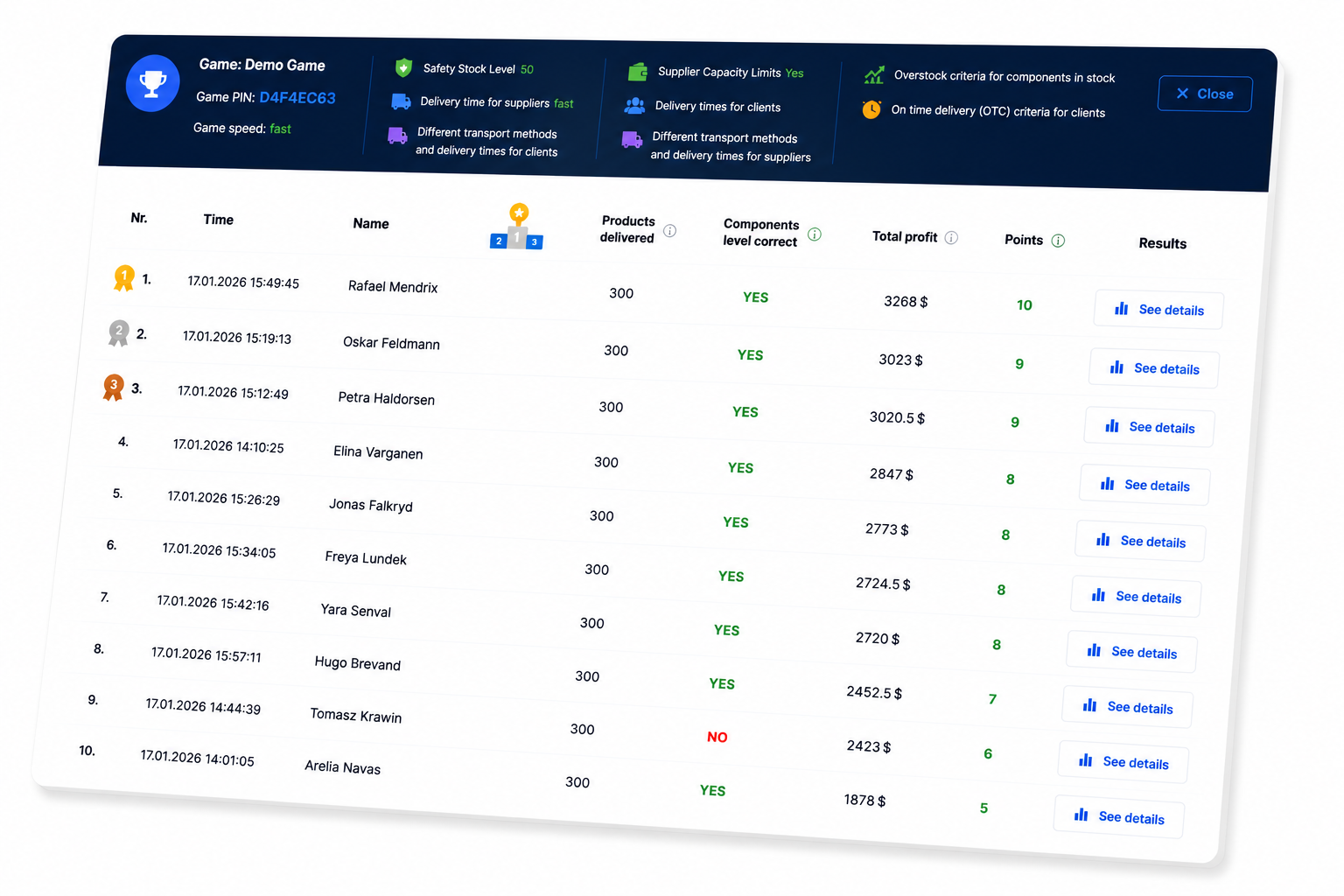
Evidence to support—not replace—assessment
Teacher’s View collects submitted results in one place. Automatic performance scores, detailed charts and rules-based feedback give instructors a consistent starting point for comparison, discussion and formative feedback.
Turn results into reflection
Use these questions after a submitted attempt to move the conversation from “what score did we get?” to “why did the system behave that way?”
Which decision had the largest effect on total profit, and why?
Where did inventory become too low or unnecessarily high?
When was faster transport worth the additional cost?
What would you change in a second attempt, and which metric should improve?
Classroom experience at Lund University
At Lund University, 101 students used ChainSim in groups of three and progressed through five simulation levels.
See how these outcomes fit your course
In a short instructor demo, we’ll show you a ready-made course, the student decision flow and the evidence available in Teacher’s View.